Stranger, if you passing meet me and desire to speak to me,
why should you not speak to me?
And why should I not speak to you?
- Walt Whitman
Nowadays, the streets are cold.
Callus fingers, callous people.
We take steps with music in our ears,
And mind not here.
My Destination.
Wary of privacy, the politically correct.
Stories lost across our glances,
Silence on the streets.
Sunday, December 26, 2010

Wednesday, December 8, 2010
ASH = Ambassadors for Sustained Health
It's hard not to feel disheartened by the overcast lingering above America over the last couple years - unemployment, idiot politicians, health care costs, economic worries, impending wars, etc. Naturally, ethnocentric issues take priority. But we also forget that our situation, in its most dismal perceptions, is incomparable to the basic, life-threatening issues that other human beings face on a daily basis. Marginalized societies, that do not have the benefit of excessive media coverage, persevere without any acknowledgment of their insufferable livelihoods.
To voice and magnify such inequality, a group of students from my alma mater recently launched an inspiring non-profit organization - ASH - to combat our world's health crisis. ASH builds and sustains community centers in poverty-stricken countries to promote health initiatives holistically - addressing multiple barriers to health-care at once, such as access to medicine and doctors, income and jobs, preventive education, water (list goes onnn).
Their first community center launched in Wamuini, Kenya. They empower the local residents to invest their own labor, land, and time into the community center, creating a spiritual and motivational bond to keep the center self-operating. Within the center, ASH has already built a vocational center for girls, a medical dispensary, and classrooms, while employing a full staff of nurses, instructors, and counselors.
The accomplishments thus far may seem like a droplet within an ocean. But the vision is pure, and ASH hopes to provide the impetus and compassion for rebuilding communities world-wide. One community at a time.
Please learn more.
Feel free to visit weareash.org or ask myself for more information on how you can help!
To voice and magnify such inequality, a group of students from my alma mater recently launched an inspiring non-profit organization - ASH - to combat our world's health crisis. ASH builds and sustains community centers in poverty-stricken countries to promote health initiatives holistically - addressing multiple barriers to health-care at once, such as access to medicine and doctors, income and jobs, preventive education, water (list goes onnn).
Their first community center launched in Wamuini, Kenya. They empower the local residents to invest their own labor, land, and time into the community center, creating a spiritual and motivational bond to keep the center self-operating. Within the center, ASH has already built a vocational center for girls, a medical dispensary, and classrooms, while employing a full staff of nurses, instructors, and counselors.
The accomplishments thus far may seem like a droplet within an ocean. But the vision is pure, and ASH hopes to provide the impetus and compassion for rebuilding communities world-wide. One community at a time.
Please learn more.
Feel free to visit weareash.org or ask myself for more information on how you can help!
Saturday, November 20, 2010
Chinese Finger Trap

Thursday, November 11, 2010
Less is (much) more
No, this is not a lesson in writing essays, nor a recommendation on the serving size for our daily meals. Take a look around your room, your home, your dresser, your car, your work desk, your brain. I'm referring to all the clutter and possessions that merely collect dust. Your clothing and accessories, for example, most likely follow the almighty 80/20 rule, in that you only wear 20% of everything you own.
Why is this? What compulsiveness and desires drive us to buy buy buy? And to what effective end, if our material possessions merely lose its utility and repeatedly become junk?
Or maybe it's an inability to let go of our possessions. Is there a symbolic association with the material as a replacement for the immaterial?
With less focus on things that might improve our feelings temporarily, we can have more time for the everlasting. Love, friendship, family. These values are self-sustaining and have driven the purpose of our existence, regardless of which paleontological era or the extent of our consumerism. So, comb through the junk and look a little deeper. What you'll find has always been there, but can offer so much more.

Why is this? What compulsiveness and desires drive us to buy buy buy? And to what effective end, if our material possessions merely lose its utility and repeatedly become junk?
Or maybe it's an inability to let go of our possessions. Is there a symbolic association with the material as a replacement for the immaterial?
With less focus on things that might improve our feelings temporarily, we can have more time for the everlasting. Love, friendship, family. These values are self-sustaining and have driven the purpose of our existence, regardless of which paleontological era or the extent of our consumerism. So, comb through the junk and look a little deeper. What you'll find has always been there, but can offer so much more.
Saturday, October 16, 2010
Saving the World with a Fishbone Diagram
In my attempt to save the world, it is particularly difficult for me to balance idealism with practicality when I try to comprehend the myriad of problems affecting our world. When I want to volunteer or donate money, I am confronted with an endless list of charitable causes. I don't know if it is inspiring that so many charities exist, or rather depressing, that so many charities need to exist. Anyhow, I would want to make sure that my time/money is spent effectively to create as significant an impact as possible. I used a quick, mental fishbone diagram to correlate some of the issues in our world and to pinpoint the key problems that if tackled first, could possibly ripple as positive externalities further down the chain.
So, to save world, I've decided to focus on two issues: EDUCATION and SUSTAINABILITY. I know these two areas are complex in themselves, but I believe we can address many issues at once by tackling these two root causes. Or maybe I am just lying to myself.
Sustainability
1. No other problem in this world will matter if our planet does not exist (or on the flip-side, all issues will be resolved if our planet no longer existed).
2. Less dependence on fossil fuels can lower our dependence on foreign countries, improve national security, and mitigate foreign wars
3. Developing renewable technology creates jobs (that are harder to outsource) and helps boost the economy
4. Sustainable eating improves animal welfare and encourages healthier lifestyles that help lower obesity, diseases, and health care costs
5. Environmental cleanliness helps third-world countries eradicate diseases like malaria, hepatitis, cholera, etc.
6. Sustainable manufacturing can decrease the shitload of chemicals in our lives that contribute to everything from ED to cancer.
Education
1. Lowers crime rate of all sorts - home violence, animal abuse, robberies, etc.
2. Creates more job opportunities, a more competitive workforce, and a stronger economy
3. Thus, poverty and homelessness
4. An awareness for healthier lifestyle choices that combat diet-related diseases and AIDS/sexual health
5. Promotes (arguably) Tolerance, Understanding, and Compassion - the effect would be far-reaching

So, to save world, I've decided to focus on two issues: EDUCATION and SUSTAINABILITY. I know these two areas are complex in themselves, but I believe we can address many issues at once by tackling these two root causes. Or maybe I am just lying to myself.
Sustainability
1. No other problem in this world will matter if our planet does not exist (or on the flip-side, all issues will be resolved if our planet no longer existed).
2. Less dependence on fossil fuels can lower our dependence on foreign countries, improve national security, and mitigate foreign wars
3. Developing renewable technology creates jobs (that are harder to outsource) and helps boost the economy
4. Sustainable eating improves animal welfare and encourages healthier lifestyles that help lower obesity, diseases, and health care costs
5. Environmental cleanliness helps third-world countries eradicate diseases like malaria, hepatitis, cholera, etc.
6. Sustainable manufacturing can decrease the shitload of chemicals in our lives that contribute to everything from ED to cancer.
Education
1. Lowers crime rate of all sorts - home violence, animal abuse, robberies, etc.
2. Creates more job opportunities, a more competitive workforce, and a stronger economy
3. Thus, poverty and homelessness
4. An awareness for healthier lifestyle choices that combat diet-related diseases and AIDS/sexual health
5. Promotes (arguably) Tolerance, Understanding, and Compassion - the effect would be far-reaching
Saturday, September 11, 2010
Want to achieve Nirvana? Have a stroke.
This 20 minute video changed my life - please take a moment to watch Jill Taylor's brilliant insight into the workings of her own brain(s) as she suffered from a stroke.
Interestingly, her (un)fortunate experience revealed an opportunity to taste enlightenment.
The scientific dissection of her stroke implied we have a biological ability to balance reality with metaphysics, practicality with spirituality, and rationality with empiricism. While science often encourages the formers and religion often encourages the latters, biology encourages both.
In translation, I believe my advocacy for a "zen" life is biologically instinctual, and more importantly, achievable through a conscious effort. Our daily ebb and flow between the worries of 'yestertomorrow' and the need for contentment is a mind battle within our own brains!
Like any other fight, we must first calm down and then listen to other side. In doing so, we might have to sometimes tune down the left side of our brains or take a peek into our right side. Eventually, it seems that in finding our own perfect balance, we can bring zen - and peace - to our daily living.
Wednesday, August 25, 2010
We are not a Democracy

More specifically, we are not a direct democracy. We are a representative democracy. The difference is crucial! In light of the recent political/ideological warfare over Muslims and gays, I keep hearing the complaint from Republican leaders that Obama/Democrats are not listening to a majority of the American people.
Here's a history lesson. America's Founding Fathers purposely instituted a representative democracy because they realized, quite frankly, the masses are stupid. Elected officials and sound-minded Supreme Court justices are not responsible for simply listening to the public. On the contrary, they must avoid the changing whims and emotions of the masses to be judicious and prudent. Otherwise, the progress of our nation will be impossible!
Take a look back: an overwhelming majority of Americans once supported slavery and denied basic human rights to colored folks. How about public segregation? Women's suffrage? Japanese internment camps? Salem witch trials? etc.
In hindsight, it seems humorous, even embarrassing, to think Americans actually supported such discriminatory policies. But, we didn't just act with indifference - we enforced these laws, suppressed minority groups, and refused to change. Our minds were ingrained with self-righteousness and intolerance. True leaders, whether in the Courts or Congress, did not succumb to the prejudices of the majority, but instead, slowly reshaped our fears and ignorance.
So, is it possible at all that we still fall to our egos today?! We can only ask ourselves as we fight so passionately, and even worse, blindly, about the issues of our time - immigration, gay marriage, Islam, animal rights, etc.
Monday, August 23, 2010
Steve Jobs
Lloyd Blankfein
Ralph Lauren
Howard Schultz
John Rockefeller
Larry Ellison
Richard Branson
What do these people (and many more) have in common? They're filthy rich. They're top CEO's of corporate America. They're male (haha). And they were all once dirt poor. They came from lower-class families and many never experienced formal schooling. In fact, two-thirds of the world's 946 billionaires created their fortunes from nothing.
So my point?
- Why not you?
- Forget choosing a path. Just start walking.
- Give before you Receive.
- College/MBA..is it honestly for YOU?
- Success was never their goal or dream.
- Tone down the cynicism.
- You are your greatest resource.
- Go for it.
Lloyd Blankfein
Ralph Lauren
Howard Schultz
John Rockefeller
Larry Ellison
Richard Branson
What do these people (and many more) have in common? They're filthy rich. They're top CEO's of corporate America. They're male (haha). And they were all once dirt poor. They came from lower-class families and many never experienced formal schooling. In fact, two-thirds of the world's 946 billionaires created their fortunes from nothing.
So my point?
- Why not you?
- Forget choosing a path. Just start walking.
- Give before you Receive.
- College/MBA..is it honestly for YOU?
- Success was never their goal or dream.
- Tone down the cynicism.
- You are your greatest resource.
- Go for it.
Friday, August 20, 2010
Why don't we THINK for ourselves anymore?

It's a tragedy - 0ne of humankind's most pervasive (in my humble opinion). We simply do not Think anymore. Even worse, Thinking is no longer a prerequisite for survival. We no longer have to think about any of the wonders that keep us alive - from the food we eat to the water we drink. Ah, some might disagree - why, I Think and make choices every single day! I never speak in absolutes, but hear me out.
As infants, we are filled with natural curiosity and creativity. We are inherently spontaneous, explorers, empiricists. However, as our cognitive abilities develop and we progress through our childhoods, rarely do we retain our creative energy. Instead, we are nurtured and conditioned to be imitators. Our parents enforce some level of religious or moral indoctrination, our education system ingrains textbooks of information into our minds, all while creativity and imagination is suppressed to the lowest priority of our mental development (I highly recommend watching this TED talk).
As our intelligence accumulates, we copy, self-insert, and paste the thoughts of theorists, peers, professors, math books, holy texts, social fabs, etc...but at the expense of developing our intellect - our ability to reason, challenge, and Think. Our penchant to identify with a certain group - religion, company, class, culture, occupation, nation, what have you - is not only self-isolating, but also grants someone else to do your Thinking for you! How much of your knowledge is derived from another person/source versus personally discovered, reasoned, or experienced?
Why does this matter? Direct experience brings us joy, happiness! We try so hard to not be discontent, but it does not come through effort! It does not come through ambition, power, elitism, asceticism, success (you tell me, does it?). Try to recall a time when your creative juices were flowing. I am not necessarily referring to your capacity to paint a picture or write a poem. We have all experienced the moments, however ephemeral, of feeling our creative energies as we directly experience or discover something unknown to ourselves. Remember those moments? How effortless! How natural! How invigorating! How alive we feel!
Don't be afraid. To think for yourself and know yourself, how can you isolate yourself by identifying and believing - so wholeheartedly - in that which you are not? In others who you are not? Otherwise, you would not be discontent. Be like an infant again, and let your walls and inhibitions down. Explore, create, and Think for yourself - without the thousands of outside voices. What follows, will surely be.
Friday, August 6, 2010
Look inside!
One of the reasons I enjoy, or rather need, to update my blog (except for the occasional hiatus) is because doing so forces me to reflect back on my life and experiences. It's unfortunately too easy and convenient for us to live without being conscious, being awake. We can read an awe-inspiring book or watch a life-motivating movie, but the effect evaporates as quickly as the next event in our schedule arrives. How often do we consciously reflect upon these opportunities for self-betterment? We can go through an entire day and head straight to bed without thinking twice about what we learned today or what we discovered about ourselves. Heck, years can go by in the blink of an eye as if we never lived them, because we most likely didn't live them.
Some of us can be fine with it, but I bet a lot us can't get rid of the nagging feeling of emptiness-no matter how many years of marriage, number of children, our dollars in our account. So we say we're trying to search for happiness, but honestly, can you really find happiness. Happiness cannot materialize; it is derived, it is achieved through being. Our attempts, ranging from religiosity to asceticism, are searches for permanence, security, satisfaction - not happiness.
How can we be happy if we do not self-reflect to learn and know ourselves? We are unique beings (duh?). So why do we go forth following teachers, priests, and parents and expect to find the truth through their eyes? To "find" happiness through their eyes?
My point is this: look inside yourself.
How? There's lots of ways - each of us should have our own way. But for a good starting point, I am reminded of what a dear friend I met in India said to me: instead of trying to have what you want; try to want what you have!

Some of us can be fine with it, but I bet a lot us can't get rid of the nagging feeling of emptiness-no matter how many years of marriage, number of children, our dollars in our account. So we say we're trying to search for happiness, but honestly, can you really find happiness. Happiness cannot materialize; it is derived, it is achieved through being. Our attempts, ranging from religiosity to asceticism, are searches for permanence, security, satisfaction - not happiness.
How can we be happy if we do not self-reflect to learn and know ourselves? We are unique beings (duh?). So why do we go forth following teachers, priests, and parents and expect to find the truth through their eyes? To "find" happiness through their eyes?
My point is this: look inside yourself.
How? There's lots of ways - each of us should have our own way. But for a good starting point, I am reminded of what a dear friend I met in India said to me: instead of trying to have what you want; try to want what you have!
Friday, May 21, 2010
20 bucks
I gave 20 bucks today to a complete stranger. Yup, walked straight up to a random, middle-aged lady and handed her a 20. Her surprised reaction was expected, but my reaction was not.
Admittedly, my interest in this experiment was driven partly by curiosity, a sense of self-righteousness, and a bit of ego. I told her to do whatever she wanted with the 20 bucks - keep it, spend it, drop it, give it forward. As I walked away, I was filled - more like, overwhelmed - with compassion. 20 bucks is not a lot of money, to me. But through another pair of eyes, 20 bucks can be a tangible difference. No matter how the lady proceeded with the 20 dollar bill, I felt like my simple act sent a rippling effect along a string of unmet lives.
To that effect, I realized that my every action, every moment, every day -however mundane and ordinary- has a causal effect on the people and environment around me. Every door I hold and "thank you" I say. Every smile I lift and car I yield to. My effect on other human beings is unknown, boundless, and GODly. Just imagine if we consciously considered our every action as a potential source of benevolence (or malevolence). If grasped, the idea is incredibly life-changing. Think about it. We are all connected.
Admittedly, my interest in this experiment was driven partly by curiosity, a sense of self-righteousness, and a bit of ego. I told her to do whatever she wanted with the 20 bucks - keep it, spend it, drop it, give it forward. As I walked away, I was filled - more like, overwhelmed - with compassion. 20 bucks is not a lot of money, to me. But through another pair of eyes, 20 bucks can be a tangible difference. No matter how the lady proceeded with the 20 dollar bill, I felt like my simple act sent a rippling effect along a string of unmet lives.
To that effect, I realized that my every action, every moment, every day -however mundane and ordinary- has a causal effect on the people and environment around me. Every door I hold and "thank you" I say. Every smile I lift and car I yield to. My effect on other human beings is unknown, boundless, and GODly. Just imagine if we consciously considered our every action as a potential source of benevolence (or malevolence). If grasped, the idea is incredibly life-changing. Think about it. We are all connected.
Monday, April 26, 2010
Are you an IDEA worth spreading?
I attended a TEDx conference today at BU (FYI - TEDx is a series of local conferences across the globe that stems from TED, an organization that invites remarkable people from all walks of life to give a mini-spiel about their life's work - "ideas worth spreading"). As always, the TED talks left me speechless - awed with inspiration, drawn by intrigued, and most importantly, empowered to act.
The conference invited speakers mostly around my young age, but to my envy (and inspiration), have all accomplished something in their lives worth spreading. The speakers were not molds of their stereotypes. They were forward thinkers, listeners of their calling, champions of a cause, etc. A blond ditsy girl, straight out of college, flew to Kenya and successfully built an orphanage (www.flyingkitesglobal.org) for a desperate community. A son of Indian immigrants, strayed from a "professional" path to engage in his love for hip-hop, and just recently, opened at the House of Blues Boston for Kid Cudi (http://aviator.bandcamp.com). A BU Japanese exchange student flew to the sinking island of Tuvalu to record a video on the effect of climate change on one of the world's smallest, and fastest dying, countries.The list goes on...and I become ashamed/jealous as I fret over what greater cause or purpose I have impacted in the first 21 years (young, but nonetheless long) of my life or that I have yet to create an idea out of my life that is worth spreading.
I realize that self-reflection is often the critical, missing element to connect and prod one from simply inhaling an idea...to taking action. We all have seen the sad commercials of starving children or sat in on an inspiring lecture. However, as soon as we get up and leave the building, the inspiration quickly dissipates and we regress to the silly, insignificant headaches of our daily schedule. I stress self-reflection because I believe the speakers of the TEDxBU conference and larger community all prevailed in taking proactive action for their passions, versus settling down in the comforts of middle class job security and lying to oneself with excuses to act "one day."
I currently sit at this crossroad, but I certainly received the extra push I needed. I know that I, and you, are filled with latent ideas or dreams we shove in the back of our minds in the "unpractical" category. Nothing is more practical than our happiness. We make a conscious decision every single day of our lives to be happy or not. When we are happy, the joy spreads so naturally from us, and our lives, become the idea that is worth spreading.

The conference invited speakers mostly around my young age, but to my envy (and inspiration), have all accomplished something in their lives worth spreading. The speakers were not molds of their stereotypes. They were forward thinkers, listeners of their calling, champions of a cause, etc. A blond ditsy girl, straight out of college, flew to Kenya and successfully built an orphanage (www.flyingkitesglobal.org) for a desperate community. A son of Indian immigrants, strayed from a "professional" path to engage in his love for hip-hop, and just recently, opened at the House of Blues Boston for Kid Cudi (http://aviator.bandcamp.com). A BU Japanese exchange student flew to the sinking island of Tuvalu to record a video on the effect of climate change on one of the world's smallest, and fastest dying, countries.The list goes on...and I become ashamed/jealous as I fret over what greater cause or purpose I have impacted in the first 21 years (young, but nonetheless long) of my life or that I have yet to create an idea out of my life that is worth spreading.
I realize that self-reflection is often the critical, missing element to connect and prod one from simply inhaling an idea...to taking action. We all have seen the sad commercials of starving children or sat in on an inspiring lecture. However, as soon as we get up and leave the building, the inspiration quickly dissipates and we regress to the silly, insignificant headaches of our daily schedule. I stress self-reflection because I believe the speakers of the TEDxBU conference and larger community all prevailed in taking proactive action for their passions, versus settling down in the comforts of middle class job security and lying to oneself with excuses to act "one day."
I currently sit at this crossroad, but I certainly received the extra push I needed. I know that I, and you, are filled with latent ideas or dreams we shove in the back of our minds in the "unpractical" category. Nothing is more practical than our happiness. We make a conscious decision every single day of our lives to be happy or not. When we are happy, the joy spreads so naturally from us, and our lives, become the idea that is worth spreading.
Tuesday, April 13, 2010
"In the moment" ... "In the zone"

Here's a great post on Zen Habits (a daily must-read for me) that reflects my advocacy for simplicity, mindfulness, and contentment in daily living. The "Zen of doing" may be hard to comprehend at first, but we've all experienced it before. Try to compare it to thinking/acting "in the moment" or when you're "in the zone." Whether it's the last 5 minutes of an exam and you're scrambling to finish your last page of questions, or you're stuck in a burning house with your adrenaline pumping, the Zen of daily doing tries to replicate that amazing feeling -- when time is frozen, mind is completely focused, and natural action precedes too much thinking-- to all the mundane acts of our daily lives. When such is achieved, welcome to enlightenment.
Sunday, April 4, 2010
I am not a tourist. I am a traveler.
Most people who know me know that I am a traveler. I acknowledge I am a fortunate human, especially for the opportunities I've had in my life to see the world, its peoples, and its wonders. At my core, I am wanderer. The comforts of a settled life or career/financial success, etc...may be ideals for most people, but for me, drains my passions and cuts off my life.
My travels are not for fun, per se, in the tourist sense. Rather, my travels are mentally fulfilling, physically challenging, and spiritually enlightening.
I do not vacation to simply take a picture of an old/new structure or lie on a white beach. I travel in order to learn about the livelihoods of our world's amazingly diverse cultures and natural environments. I look for the commonalities that help me understand myself by understanding others. I search for happiness by examining the roots of happiness in others. I dig under the political crap and technological barriers that bombard my life in order to connect with the basic, universal human needs that tie all of us together, despite our worldly issues. I return to the source of our existence - nature - to discover beauty in simplicity. I reassess the desires of my modern life, the drivers of my rat race. I fulfill my curiosity to see a glimpse of the trillions of molecular formations outside of my personal bubble. I break my own a priori assumptions and cynicism about humanity. I free my mind from my own limits.
Well, I'm excited to proclaim that my next stop is India - one of the oldest civilizations, both in the religious and paleontological sense. I'm not just intrigued by the taboos of Bollywood or the diversity within the Indian people, its traditions, and cuisines. I really know little about India, and this obscurity that India tries to wall themselves within will certainly be a challenge I look forward to climbing over in the summer months.

My travels are not for fun, per se, in the tourist sense. Rather, my travels are mentally fulfilling, physically challenging, and spiritually enlightening.
I do not vacation to simply take a picture of an old/new structure or lie on a white beach. I travel in order to learn about the livelihoods of our world's amazingly diverse cultures and natural environments. I look for the commonalities that help me understand myself by understanding others. I search for happiness by examining the roots of happiness in others. I dig under the political crap and technological barriers that bombard my life in order to connect with the basic, universal human needs that tie all of us together, despite our worldly issues. I return to the source of our existence - nature - to discover beauty in simplicity. I reassess the desires of my modern life, the drivers of my rat race. I fulfill my curiosity to see a glimpse of the trillions of molecular formations outside of my personal bubble. I break my own a priori assumptions and cynicism about humanity. I free my mind from my own limits.
Well, I'm excited to proclaim that my next stop is India - one of the oldest civilizations, both in the religious and paleontological sense. I'm not just intrigued by the taboos of Bollywood or the diversity within the Indian people, its traditions, and cuisines. I really know little about India, and this obscurity that India tries to wall themselves within will certainly be a challenge I look forward to climbing over in the summer months.
Saturday, April 3, 2010
China vs Google

Kudos to Google for trying to maintain its integrity by taking on the Middle Kingdom.
(Even the US doesn't have enough balls to convince China from manipulating the Yuan...or carelessly overlooking its environmental duties for the sake of economic growth...or suppressing the voices of its "autonomous regions"...or censoring any voice that tries to dissent the communist party...or establishing military/business partnerships that disregard human rights in foreign countries...or etc...)
Firstly, I do commend Google for standing by its "Do no Evil" motto. Although I am not sure I'd go as far as calling censorship "evil", I also do realize that Google is a for-profit business. As such, if a business desires to enter into foreign markets, it should naturally follow the country's own laws and regulations. This is no different than the requirement for businesses to face different tax laws, government safety regulations, etc.
Google, as a symbolic representation of America's freedom of speech/print, obviously clashes with China's own interpretation as to how to best govern its people. While, western (esp. American) ideals are driven by individualism and self-righteousness, Chinese beliefs follow traditional Confucian teachings of obedience and national/filial piety. As a Chinese American, I understand how these ideologies are fundamentally different and require different approaches to government. Democracy undercuts China's penchant for authority (much like a father ruling his children like an iron-fist), and censorship undercuts the Western system of free information (and optimistic trust in its citizens). Both systems work (more or less), and its arguable which one works better...

Wednesday, March 10, 2010
Care about healthcare
I got the unlucky opportunity to experience the feeling of unemployment for 1 month after graduation, and let me reiterate to myself, it wasn't great. The crux of its dreadfulness was not having health care. For my whole life, into my invincible college years, I never gave health care an afterthought. I never got sick, didn't visit a doctor otherwise, and always had my parent's arms to fall back on. However, once I was officially off my parent's lifesaver, I finally understood why Obama and most Dems are fanatically pushing an overhaul of our current health care system to include millions of living, breathing Americans who are unemployed/insured.
It is despicably easy for us (those with health care) to settle with the status quo and erase from our minds the suffering of the uninsured. The pain of fathoming a life of sudden death, cornered between literal survival and the artificiality of monetary survival, is heart-breaking. Albeit, I feel little remorse for the deserving handful of lazy, fat, smoking, self-induced, disease-prone bums. The majority, however, are innocent from their nurtured environments, ignorant or incapable of self-preservation and self-promotion. As pawns of the rat race, pushed by the same universal ideals to care for one self and loved ones, it is disconcerting to see corporate greed overcome basic human rights.
I hope our politicians will act with virtue.
It is despicably easy for us (those with health care) to settle with the status quo and erase from our minds the suffering of the uninsured. The pain of fathoming a life of sudden death, cornered between literal survival and the artificiality of monetary survival, is heart-breaking. Albeit, I feel little remorse for the deserving handful of lazy, fat, smoking, self-induced, disease-prone bums. The majority, however, are innocent from their nurtured environments, ignorant or incapable of self-preservation and self-promotion. As pawns of the rat race, pushed by the same universal ideals to care for one self and loved ones, it is disconcerting to see corporate greed overcome basic human rights.
I hope our politicians will act with virtue.
Thursday, February 25, 2010
Sentiments once my blood,
I welcome the flood,
Actions I pursued,
Smooth as a canoe,
The high of no sense,
My fate none more immense,
Spontaneity I thrived,
I breathed with forsaken blithe,
All with the ebb and flow,
What unknown I know.
The matrix invades.
Passions now stiff,
A pawn of the myth,
Contained like a bum,
The dark I turn from,
As cycles I churn,
The dreams I burn,
I yawn to be free,
But change I bury,
Thoughts my enemy,
I ask if I am me,
As I become what I've feared.
I welcome the flood,
Actions I pursued,
Smooth as a canoe,
The high of no sense,
My fate none more immense,
Spontaneity I thrived,
I breathed with forsaken blithe,
All with the ebb and flow,
What unknown I know.
The matrix invades.
Passions now stiff,
A pawn of the myth,
Contained like a bum,
The dark I turn from,
As cycles I churn,
The dreams I burn,
I yawn to be free,
But change I bury,
Thoughts my enemy,
I ask if I am me,
As I become what I've feared.
Saturday, February 13, 2010
Tuesday, February 9, 2010
I need to rant about Sarah Palin
I try to eschew topics involving political drama, but I cannot sit quietly as Sarah Palin builds her empire as a media whore. From the moment I heard of her existence as the Republican VP nominee, I couldn't believe the amount of attention and support she has received. The mere fact that human beings (Americans, unfortunately) actually revere and elected (what's wrong with these Alaskans?!) a barbie, brain fart like Sarah Palin is unconsciously embarrassing. I am ashamed, appalled, and annoyed. Her character reeks of dishonesty and superficiality. All of her interviews reveal an intelligence level on par with a donkey that can wink with one eye. She manages to suck out attention through her MILF beauty, catty cliches, and an insincere abuse of stupid Americans who fail to hear the crap that flushes out of her mouth. AHH. How do I let myself live in a country with morons and run by morons.?!

Monday, February 8, 2010
My Poetic Attempt
I decided to start writing poetry in my posts. I've dabbled in the art back in the day, but have never been much of a fan (or considered good at it). Still, I expect the thinking and writing process of a poem to challenge my limits and twist my cognitive patterns. To that end, I have no preference, experience, nor appreciation for formalities. I will simply write what flows out of me.
Unfortunately, I currently have a brain-freeze...and will wait until inspiration strikes.
Unfortunately, I currently have a brain-freeze...and will wait until inspiration strikes.
Sunday, February 7, 2010
Secrets
PostSecret is hands down one of the best blogs out there. It's fascinating how one postcard can encapsulate the human psyche and strike my innards with such emotional power. Some posts are a little out there, some are hilarious, and some are pure genius. Either way, I understand the common need as humans to connect and relate to each other. I am reminded of my own faults, my overlooked eccentricities, my successes, my disgraces, my own life. Check it out (if for some reason you haven't yet).
Wednesday, January 27, 2010
Too Much Stuff
Apple, Inc. introduced the iPad today to add to its list of must-have gadgets. The raves and commotion over a piece of metal is disconcerting and reminds me of Annie Leonard's Story of Stuff. Our one-way form of consumerism...
limited inputs+synthetic chemicals+abused, cheap labor+ecological damage/emissions--> lots of useless stuff-->lots of useless trash--> more environmental damage
...cannot be sustained. Humans often inadvertently repeat the mistakes of history, and the greatest civilizations throughout history (think Romans, Mayans) have been wiped out from a depletion of resources (or the resulting warfare).
People do not realize the cyclical nature of consumerism, fueled by a deeper void--a dissatisfaction, a meaningless connection with our lives. We try to derive happiness from superficial means that do not last. We desire the iPod, which eventually becomes obsolete. We then desire the iPhone, which eventually becomes obsolete. We then desire the iPad, which eventually..you get the point. Instead, try to find a connection with something/one lasting. Try nature, love, God (if you must). But first acknowledge your cyclical habits and understand its negative implications on the outside world and your own personal happiness.

limited inputs+synthetic chemicals+abused, cheap labor+ecological damage/emissions--> lots of useless stuff-->lots of useless trash--> more environmental damage
...cannot be sustained. Humans often inadvertently repeat the mistakes of history, and the greatest civilizations throughout history (think Romans, Mayans) have been wiped out from a depletion of resources (or the resulting warfare).
People do not realize the cyclical nature of consumerism, fueled by a deeper void--a dissatisfaction, a meaningless connection with our lives. We try to derive happiness from superficial means that do not last. We desire the iPod, which eventually becomes obsolete. We then desire the iPhone, which eventually becomes obsolete. We then desire the iPad, which eventually..you get the point. Instead, try to find a connection with something/one lasting. Try nature, love, God (if you must). But first acknowledge your cyclical habits and understand its negative implications on the outside world and your own personal happiness.
Monday, January 25, 2010
We all want to be special. But I want to be general.
I am only 21, but I've already worked in 10 jobs and 5 industries. My life is fueled by curiosity. I pounce on new adventures and opportunities. I drive conversations about fresh ideas and other perspectives. I learn new concepts to keep my brains oiled and inspired. I cannot sit idly knowing there is simply too/so much in this world for us to experience--without enough time.
A look at society kills my ambitions. A career requires us to sharpen our skills in one particular field and continue building credentials and expertise. A debutante is not appreciated, but merely an inexperienced hassle to train. We seek specialists and professionals. But I cannot live in a mental capsule where I am knowledgeable about nothing else except tax laws.
A look at society kills my ambitions. A career requires us to sharpen our skills in one particular field and continue building credentials and expertise. A debutante is not appreciated, but merely an inexperienced hassle to train. We seek specialists and professionals. But I cannot live in a mental capsule where I am knowledgeable about nothing else except tax laws.
Monday, January 18, 2010
What makes you happy (scientifically)?
Nicholas D. Kristof , a regular NY times op-ed contributor, discussed in a recent article an interesting experiment on happiness. "Which person would you rather be:
1. Richard is an ambitious 36-year-old white commodities trader in Florida. He’s healthy and drop-dead handsome, lives alone in a house with a pool, and has worked his way through a series of gorgeous women. Richard’s job is stressful, but he spent Christmas in Tahiti. Unencumbered, he also has time to indulge such passions as reading (right now he’s finishing a book called “Half the Sky”), marathon running and writing poetry. In the last few days, he has been composing an elegy about the Haiti earthquake.
2. Lorna is a 64-year-old black woman in Boston. She’s overweight and unattractive, even after a recent nose job. Lorna is on regular dialysis, but that doesn’t impede her active social life or babysitting her grandchildren. A retired school assistant, she is close to her 67-year-old husband and is much respected in her church for directing the music committee and the semiannual blood drive. Lorna believes in tithing (giving 10 percent of her income to charity or the church) and in the last few days has organized a church drive to raise $10,000 for earthquake relief in Haiti.
While most of us might prefer to trade places with Richard, Lorna is probably happier.
Lorna has a few advantages over Richard. She has less stress and is respected by her peers — factors that make us feel good. Happiness is tied to volunteering and to giving blood, and people with religious faith tend to be happier than those without. A solid marriage is linked to happiness, as is participation in social networks. And one study found that people who focus on achieving wealth and career advancement are less happy than those who focus on good works, religion or spirituality, or friends and family.
Other variables to consider: Men are no happier than women, and people in sunny areas no happier than people in chillier climates. The evidence on health is complex, but even chronic health problems (like those requiring dialysis) may have surprisingly little long-term effect on happiness, because we adjust to them. Beautiful people aren’t happier than ugly people, although cosmetic surgery does seem to leave patients feeling brighter. Whites are happier than blacks, but only very slightly. And young people are actually a bit less happy than older folks, at least up to age 65."
1. Richard is an ambitious 36-year-old white commodities trader in Florida. He’s healthy and drop-dead handsome, lives alone in a house with a pool, and has worked his way through a series of gorgeous women. Richard’s job is stressful, but he spent Christmas in Tahiti. Unencumbered, he also has time to indulge such passions as reading (right now he’s finishing a book called “Half the Sky”), marathon running and writing poetry. In the last few days, he has been composing an elegy about the Haiti earthquake.
2. Lorna is a 64-year-old black woman in Boston. She’s overweight and unattractive, even after a recent nose job. Lorna is on regular dialysis, but that doesn’t impede her active social life or babysitting her grandchildren. A retired school assistant, she is close to her 67-year-old husband and is much respected in her church for directing the music committee and the semiannual blood drive. Lorna believes in tithing (giving 10 percent of her income to charity or the church) and in the last few days has organized a church drive to raise $10,000 for earthquake relief in Haiti.
While most of us might prefer to trade places with Richard, Lorna is probably happier.
Lorna has a few advantages over Richard. She has less stress and is respected by her peers — factors that make us feel good. Happiness is tied to volunteering and to giving blood, and people with religious faith tend to be happier than those without. A solid marriage is linked to happiness, as is participation in social networks. And one study found that people who focus on achieving wealth and career advancement are less happy than those who focus on good works, religion or spirituality, or friends and family.
Other variables to consider: Men are no happier than women, and people in sunny areas no happier than people in chillier climates. The evidence on health is complex, but even chronic health problems (like those requiring dialysis) may have surprisingly little long-term effect on happiness, because we adjust to them. Beautiful people aren’t happier than ugly people, although cosmetic surgery does seem to leave patients feeling brighter. Whites are happier than blacks, but only very slightly. And young people are actually a bit less happy than older folks, at least up to age 65."
Sunday, January 17, 2010
Interdependent Origination (my take)
A recent earthquake shattered the entire country of Haiti, exacerbating an already poverty-stricken nation. On one note, I am grateful for the outpouring of compassion from citizens across the globe. However, I am also disconcerted by the few (or many) who don't think twice when changing the news channel and simply turn on an apathy switch.
It is so easy for us to go about our daily lives and worries, self-ingrained in our own lives, without recognizing what's happening throughout the world--the environment and the 7 billion people who we don't have a direct connection with. More importantly, we fail to realize each of us are parts of a whole, interconnected and interdependent for survival. From the dying bees and frogs to the micro-bacteria and fungi responsible for nature's critical cycles, we fail to care for (or even think about) these abstract, external concepts until a long term problem smacks us (hard) directly in the face by changing the price of our precious oil.
Even though we are bombarded with daily news of all sorts, we still forget that soldiers are physically dying everyday for some idealistically forgotten war. Yes, the tragedy of natural disasters is inexplicable, but the real tragedy is how we don't realize that a person dies from hunger every 3.6 SECONDS. 25,000 children die every day from poverty. 13,500 people die each day from smoking. These statistics are so powerful, yet still fail to strike an emotional chord within us. Although the Haitian catastrophe is unfortunate, please see the opportunity it brings for each of us to reassess how we go about our daily lives without really appreciating everything/one that surrounds, impacts, and influences us .

It is so easy for us to go about our daily lives and worries, self-ingrained in our own lives, without recognizing what's happening throughout the world--the environment and the 7 billion people who we don't have a direct connection with. More importantly, we fail to realize each of us are parts of a whole, interconnected and interdependent for survival. From the dying bees and frogs to the micro-bacteria and fungi responsible for nature's critical cycles, we fail to care for (or even think about) these abstract, external concepts until a long term problem smacks us (hard) directly in the face by changing the price of our precious oil.
Even though we are bombarded with daily news of all sorts, we still forget that soldiers are physically dying everyday for some idealistically forgotten war. Yes, the tragedy of natural disasters is inexplicable, but the real tragedy is how we don't realize that a person dies from hunger every 3.6 SECONDS. 25,000 children die every day from poverty. 13,500 people die each day from smoking. These statistics are so powerful, yet still fail to strike an emotional chord within us. Although the Haitian catastrophe is unfortunate, please see the opportunity it brings for each of us to reassess how we go about our daily lives without really appreciating everything/one that surrounds, impacts, and influences us .
Monday, January 4, 2010
Thatcherism
One of my New Year resolutions: more blog posts! to 1) keep my writing/thinking skills sharpened as I slowly fade from academic work and 2) allow myself more of the satisfaction from reading my thoughts years from now.
Here's a quote by Margaret Thatcher (once prime minister of UK) in 1987...but the relevance is especially applicable to today. I've supported a majority of Obama's policies, but the backlash of opinions from American myopia drives me to reassess the externalities of too much government...
"I think we have gone through a period when too many children and people have been given to understand "I have a problem, it is the Government's job to cope with it!" or "I have a problem, I will go and get a grant to cope with it!" "I am homeless, the Government must house me!" and so they are casting their problems on society and who is society? There is no such thing! There are individual men and women and there are families and no government can do anything except through people and people look to themselves first. It is our duty to look after ourselves and then also to help look after our neighbour and life is a reciprocal business and people have got the entitlements too much in mind without the obligations..."

Here's a quote by Margaret Thatcher (once prime minister of UK) in 1987...but the relevance is especially applicable to today. I've supported a majority of Obama's policies, but the backlash of opinions from American myopia drives me to reassess the externalities of too much government...
"I think we have gone through a period when too many children and people have been given to understand "I have a problem, it is the Government's job to cope with it!" or "I have a problem, I will go and get a grant to cope with it!" "I am homeless, the Government must house me!" and so they are casting their problems on society and who is society? There is no such thing! There are individual men and women and there are families and no government can do anything except through people and people look to themselves first. It is our duty to look after ourselves and then also to help look after our neighbour and life is a reciprocal business and people have got the entitlements too much in mind without the obligations..."
Friday, January 1, 2010
Memes
I wish everyone a Happy New Year/Decade of better opportunities and better lives--from myself, friends, and family to the unimaginable kids across the world suffering from thirst and love.
It's interesting how we need a new year--the illusion of time--to trigger a mental switch to reflect, reassess, and reform...when I believe such conditioning can/should be applied every day of our lives. Why is it so difficult to escape the comforts of our daily routines (mental and physical) and embrace some form of change? So difficult that even when we gather enough courage to make these habitual resolutions, attempts at change still habitually fail.
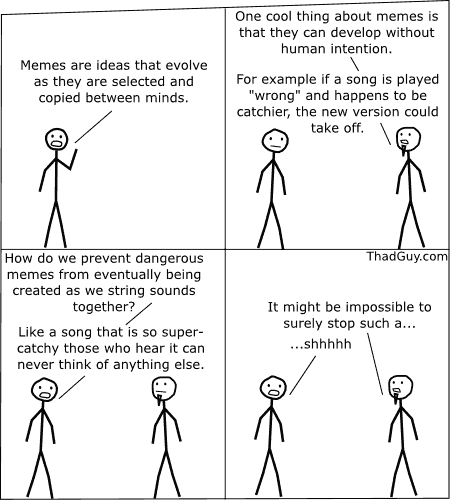
A Meme, a term coined by Richard Dawkins (one of my personally most influential authors), is a unit of cultural ideas, thoughts, practices, etc. that spread from mind to mind and become ingrained in our brains as truths (with or without the support of reason or logic). The platforms usually include parents and past generations, cultural traditions, religions, etc. Ponder on it--memes ubiquitously impact our lives, down to the mental core that drives our daily actions and future expectations. From childhood indoctrination to religious piety, memes are the reason why we think "I am suppose to do this," "I cannot do this, "I'm not allowed to do that." Point of the matter is that there is no justification for these beliefs. The spread of memes, like virus, hide behind notions, such as filial piety and cultural propriety.
Start to Question the reasons behind your thoughts and actions and you'll be amazed at how memes subconsciously influence your life. Look at fashion and the act of shaving. Viral Marketing. The rat race for job security. Social status achievement. Religious customs and promises. ETC. Try to observe these behaviors from an objective, alien perspective. Rethink your behaviors that simply react blindly to political rules and parental interests. Apply civil disobedience on behalf of your own personal values. Maybe you'll uncover how such absurdity narrows the possibilities for our living.
Subscribe to:
Posts (Atom)