Wednesday, January 27, 2010

Too Much Stuff

Apple, Inc. introduced the iPad today to add to its list of must-have gadgets. The raves and commotion over a piece of metal is disconcerting and reminds me of Annie Leonard's Story of Stuff. Our one-way form of consumerism...

limited inputs+synthetic chemicals+abused, cheap labor+ecological damage/emissions--> lots of useless stuff-->lots of useless trash--> more environmental damage

...cannot be sustained. Humans often inadvertently repeat the mistakes of history, and the greatest civilizations throughout history (think Romans, Mayans) have been wiped out from a depletion of resources (or the resulting warfare).

People do not realize the cyclical nature of consumerism, fueled by a deeper void--a dissatisfaction, a meaningless connection with our lives. We try to derive happiness from superficial means that do not last. We desire the iPod, which eventually becomes obsolete. We then desire the iPhone, which eventually becomes obsolete. We then desire the iPad, which eventually..you get the point. Instead, try to find a connection with something/one lasting. Try nature, love, God (if you must). But first acknowledge your cyclical habits and understand its negative implications on the outside world and your own personal happiness.


Monday, January 25, 2010

We all want to be special. But I want to be general.

I am only 21, but I've already worked in 10 jobs and 5 industries. My life is fueled by curiosity. I pounce on new adventures and opportunities. I drive conversations about fresh ideas and other perspectives. I learn new concepts to keep my brains oiled and inspired. I cannot sit idly knowing there is simply too/so much in this world for us to experience--without enough time.

A look at society kills my ambitions. A career requires us to sharpen our skills in one particular field and continue building credentials and expertise. A debutante is not appreciated, but merely an inexperienced hassle to train. We seek specialists and professionals. But I cannot live in a mental capsule where I am knowledgeable about nothing else except tax laws.

Monday, January 18, 2010

What makes you happy (scientifically)?

Nicholas D. Kristof , a regular NY times op-ed contributor, discussed in a recent article an interesting experiment on happiness. "Which person would you rather be:

1. Richard is an ambitious 36-year-old white commodities trader in Florida. He’s healthy and drop-dead handsome, lives alone in a house with a pool, and has worked his way through a series of gorgeous women. Richard’s job is stressful, but he spent Christmas in Tahiti. Unencumbered, he also has time to indulge such passions as reading (right now he’s finishing a book called “Half the Sky”), marathon running and writing poetry. In the last few days, he has been composing an elegy about the Haiti earthquake.

2. Lorna is a 64-year-old black woman in Boston. She’s overweight and unattractive, even after a recent nose job. Lorna is on regular dialysis, but that doesn’t impede her active social life or babysitting her grandchildren. A retired school assistant, she is close to her 67-year-old husband and is much respected in her church for directing the music committee and the semiannual blood drive. Lorna believes in tithing (giving 10 percent of her income to charity or the church) and in the last few days has organized a church drive to raise $10,000 for earthquake relief in Haiti.

While most of us might prefer to trade places with Richard, Lorna is probably happier.

Lorna has a few advantages over Richard. She has less stress and is respected by her peers — factors that make us feel good. Happiness is tied to volunteering and to giving blood, and people with religious faith tend to be happier than those without. A solid marriage is linked to happiness, as is participation in social networks. And one study found that people who focus on achieving wealth and career advancement are less happy than those who focus on good works, religion or spirituality, or friends and family.

Other variables to consider: Men are no happier than women, and people in sunny areas no happier than people in chillier climates. The evidence on health is complex, but even chronic health problems (like those requiring dialysis) may have surprisingly little long-term effect on happiness, because we adjust to them. Beautiful people aren’t happier than ugly people, although cosmetic surgery does seem to leave patients feeling brighter. Whites are happier than blacks, but only very slightly. And young people are actually a bit less happy than older folks, at least up to age 65."

Sunday, January 17, 2010

Interdependent Origination (my take)

A recent earthquake shattered the entire country of Haiti, exacerbating an already poverty-stricken nation. On one note, I am grateful for the outpouring of compassion from citizens across the globe. However, I am also disconcerted by the few (or many) who don't think twice when changing the news channel and simply turn on an apathy switch.

It is so easy for us to go about our daily lives and worries, self-ingrained in our own lives, without recognizing what's happening throughout the world--the environment and the 7 billion people who we don't have a direct connection with. More importantly, we fail to realize each of us are parts of a whole, interconnected and interdependent for survival. From the dying bees and frogs to the micro-bacteria and fungi responsible for nature's critical cycles, we fail to care for (or even think about) these abstract, external concepts until a long term problem smacks us (hard) directly in the face by changing the price of our precious oil.

Even though we are bombarded with daily news of all sorts, we still forget that soldiers are physically dying everyday for some idealistically forgotten war. Yes, the tragedy of natural disasters is inexplicable, but the real tragedy is how we don't realize that a person dies from hunger every 3.6 SECONDS. 25,000 children die every day from poverty. 13,500 people die each day from smoking. These statistics are so powerful, yet still fail to strike an emotional chord within us. Although the Haitian catastrophe is unfortunate, please see the opportunity it brings for each of us to reassess how we go about our daily lives without really appreciating everything/one that surrounds, impacts, and influences us .

Monday, January 4, 2010

Thatcherism

One of my New Year resolutions: more blog posts! to 1) keep my writing/thinking skills sharpened as I slowly fade from academic work and 2) allow myself more of the satisfaction from reading my thoughts years from now.

Here's a quote by Margaret Thatcher (once prime minister of UK) in 1987...but the relevance is especially applicable to today. I've supported a majority of Obama's policies, but the backlash of opinions from American myopia drives me to reassess the externalities of too much government...

"I think we have gone through a period when too many children and people have been given to understand "I have a problem, it is the Government's job to cope with it!" or "I have a problem, I will go and get a grant to cope with it!" "I am homeless, the Government must house me!" and so they are casting their problems on society and who is society? There is no such thing! There are individual men and women and there are families and no government can do anything except through people and people look to themselves first. It is our duty to look after ourselves and then also to help look after our neighbour and life is a reciprocal business and people have got the entitlements too much in mind without the obligations..."

Friday, January 1, 2010

Memes


I wish everyone a Happy New Year/Decade of better opportunities and better lives--from myself, friends, and family to the unimaginable kids across the world suffering from thirst and love.

It's interesting how we need a new year--the illusion of time--to trigger a mental switch to reflect, reassess, and reform...when I believe such conditioning can/should be applied every day of our lives. Why is it so difficult to escape the comforts of our daily routines (mental and physical) and embrace some form of change? So difficult that even when we gather enough courage to make these habitual resolutions, attempts at change still habitually fail.

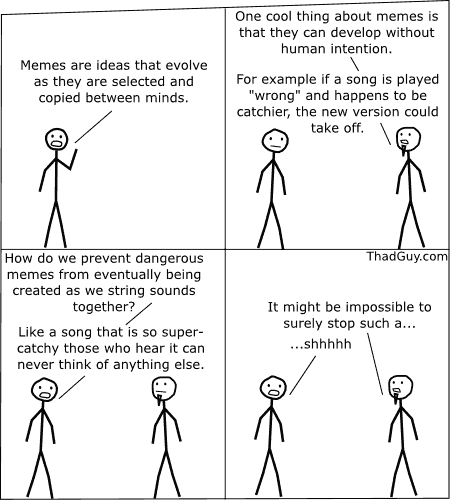
A Meme, a term coined by Richard Dawkins (one of my personally most influential authors), is a unit of cultural ideas, thoughts, practices, etc. that spread from mind to mind and become ingrained in our brains as truths (with or without the support of reason or logic). The platforms usually include parents and past generations, cultural traditions, religions, etc. Ponder on it--memes ubiquitously impact our lives, down to the mental core that drives our daily actions and future expectations. From childhood indoctrination to religious piety, memes are the reason why we think "I am suppose to do this," "I cannot do this, "I'm not allowed to do that." Point of the matter is that there is no justification for these beliefs. The spread of memes, like virus, hide behind notions, such as filial piety and cultural propriety.

Start to Question the reasons behind your thoughts and actions and you'll be amazed at how memes subconsciously influence your life. Look at fashion and the act of shaving. Viral Marketing. The rat race for job security. Social status achievement. Religious customs and promises. ETC. Try to observe these behaviors from an objective, alien perspective. Rethink your behaviors that simply react blindly to political rules and parental interests. Apply civil disobedience on behalf of your own personal values. Maybe you'll uncover how such absurdity narrows the possibilities for our living.